


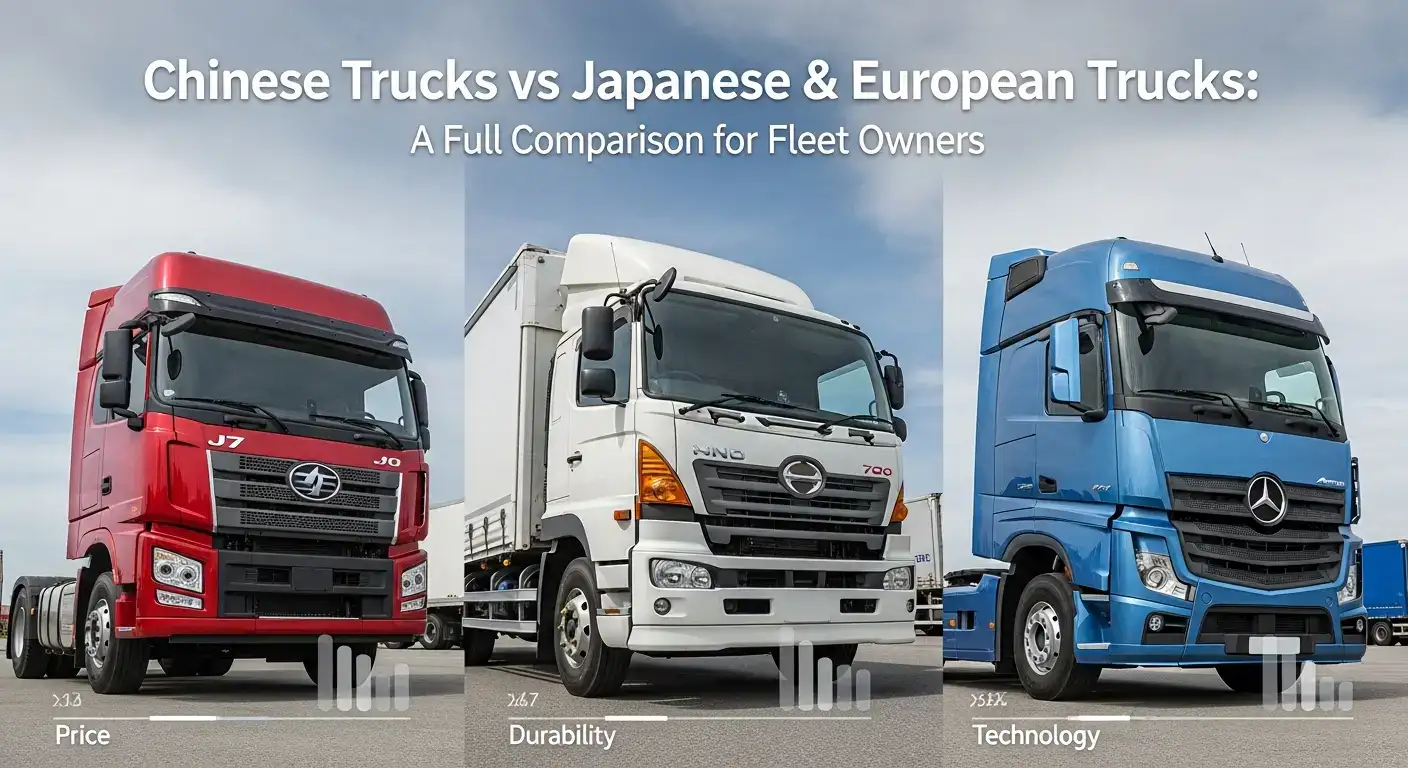
Choosing a commercial truck is not about brand prestige, it’s about total cost per hour, operational reliability, and return on investment (ROI). For fleet operators, logistics companies, and construction firms, the real question is: which truck delivers the best financial and operational performance over its lifecycle?
Chinese, Japanese, and European truck manufacturers now compete globally, but they serve different fleet strategies, budgets, and regulatory environments. This guide compares cost, reliability, total cost of ownership (TCO), maintenance, resale value, and technology so fleet decision‑makers can choose based on data, not assumptions.
Chinese trucks are best for cost‑driven fleets, rapid expansion, and buyers prioritizing fast ROI and low upfront capital.
Japanese trucks suit fleets that prioritize long‑term reliability, predictable ownership costs, and operational stability.
European trucks fit fleets operating in high‑regulation markets that require advanced safety, emissions compliance, technology, and driver comfort.
Bottom line: The best truck is the one that aligns with your operating environment, budget constraints, and lifecycle strategy.
Over the past decade, Chinese truck manufacturers such as SINOTRUK, FAW, Foton, Dongfeng, and Shaanxi Auto have rapidly expanded into Asia, Africa, the Middle East, and Latin America, driven by:
Large‑scale manufacturing capacity
Aggressive pricing strategies
Integrated supply chains
Growing export networks
Japanese brands, including Isuzu, Hino, Mitsubishi Fuso, and UD Trucks, continue to dominate markets where durability, fuel efficiency, and low lifecycle cost are prioritized over purchase price.
European OEMs — such as Volvo, Mercedes‑Benz (Daimler), Scania, and MAN — focus on premium fleets, strict emissions compliance, and advanced fleet management technology in developed and regulated regions.
Lowest upfront purchase cost
Attractive for bulk fleet procurement
Lower financial entry barrier for new fleet operators
Factory‑level customization often available
Mid‑range pricing
Strong reputation for build consistency
Stable dealer‑based pricing and resale confidence
Highest purchase cost
Pricing reflects premium engineering, safety systems, and compliance requirements
Financing often bundled with long‑term service contracts
Key insight: A lower purchase price reduces capital risk, but it does not always guarantee lower lifetime cost.
Fleet buyers should evaluate TCO instead of sticker price, especially for vehicles operated over 5–7 years.
Initial purchase price
Fuel or energy efficiency
Maintenance and service frequency
Spare parts availability and cost
Downtime impact on revenue
Insurance and compliance costs
Resale or residual value
Chinese trucks
Faster short‑term ROI
Higher maintenance variability depending on region
Best performance when proactive maintenance programs exist
Japanese trucks
Predictable long‑term ownership costs
Stable maintenance schedules
Lower unexpected repair risk
European trucks
Excellent uptime when properly serviced
Higher servicing and parts costs
Greater complexity requiring specialized diagnostics
Practical advice: Fleet operators should run custom TCO models based on duty cycle, mileage, fuel price, and local service access.
Reliability has improved significantly in recent years
Strong performance when maintenance schedules are strictly followed
Service quality depends heavily on local distributor capability
Known for mechanical simplicity and durability
Longer service intervals
Lower risk of unexpected breakdowns
Advanced engineering improves driving performance and safety
Higher system complexity increases repair costs
Downtime risk rises if parts or diagnostics are not locally available
Myth challenged: European trucks are not always more reliable — local service infrastructure often matters more than engineering alone.
Chinese brands offer affordable parts, but availability varies by market
Japanese OEMs benefit from mature dealer networks in many countries
European brands provide structured service programs, typically at a premium price
Key takeaway: For international buyers, local spare parts access often outweighs brand reputation.
Electric and hybrid commercial truck deployment
Battery supply chain integration
Cost‑efficient EV platforms
Hybrid efficiency
Gradual electrification adoption
Proven drivetrain reliability
Advanced Driver Assistance Systems (ADAS)
Telematics and fleet optimization software
Compliance‑ready EV platforms for regulated markets
Reality check: Early EV adoption only makes sense if charging infrastructure, route planning, and operational readiness are in place.
Japanese trucks generally retain the highest resale value
European trucks hold strong value in premium or regulated markets
Chinese trucks depreciate faster, but lower initial cost offsets resale impact
Fleet strategy insight: For fleets with rapid turnover cycles, depreciation speed may matter less than upfront savings.
Before selecting a truck platform, evaluate:
What is my operating environment (terrain, climate, regulations)?
How long will I retain each vehicle?
Is downtime more expensive than maintenance?
Do I have reliable local service and parts access?
Am I optimizing for cost, performance, compliance, or scalability?
Choose Chinese trucks if cost efficiency, scalability, and fast ROI are your top priorities.
Choose Japanese trucks if long‑term reliability, resale value, and predictable ownership costs matter most.
Choose European trucks if regulatory compliance, safety technology, and premium performance justify higher investment.
Main takeaway: Fleet decisions should be driven by objective data, operational priorities, and financial modeling, not brand perception.
Planning to expand or upgrade your fleet?
Request supplier quotations
Compare TCO models by region and duty cycle
Consult a fleet specialist who understands your market, budget, and logistics challenges
A data‑driven truck purchase today can save millions in operational cost over time.
Chinese vs Japanese vs European Trucks: Cost, Reliability & Fleet ROI Comparison
READ FULLThe Ultimate Guide to Buying a Used Truck in 2025. Purchasing a used truck can be a wis
READ FULLImporting used trucks from China may seem like a significant leap, but for many businesses, it&rs
READ FULL